What's In This Guide
The 1932 Summer Olympics
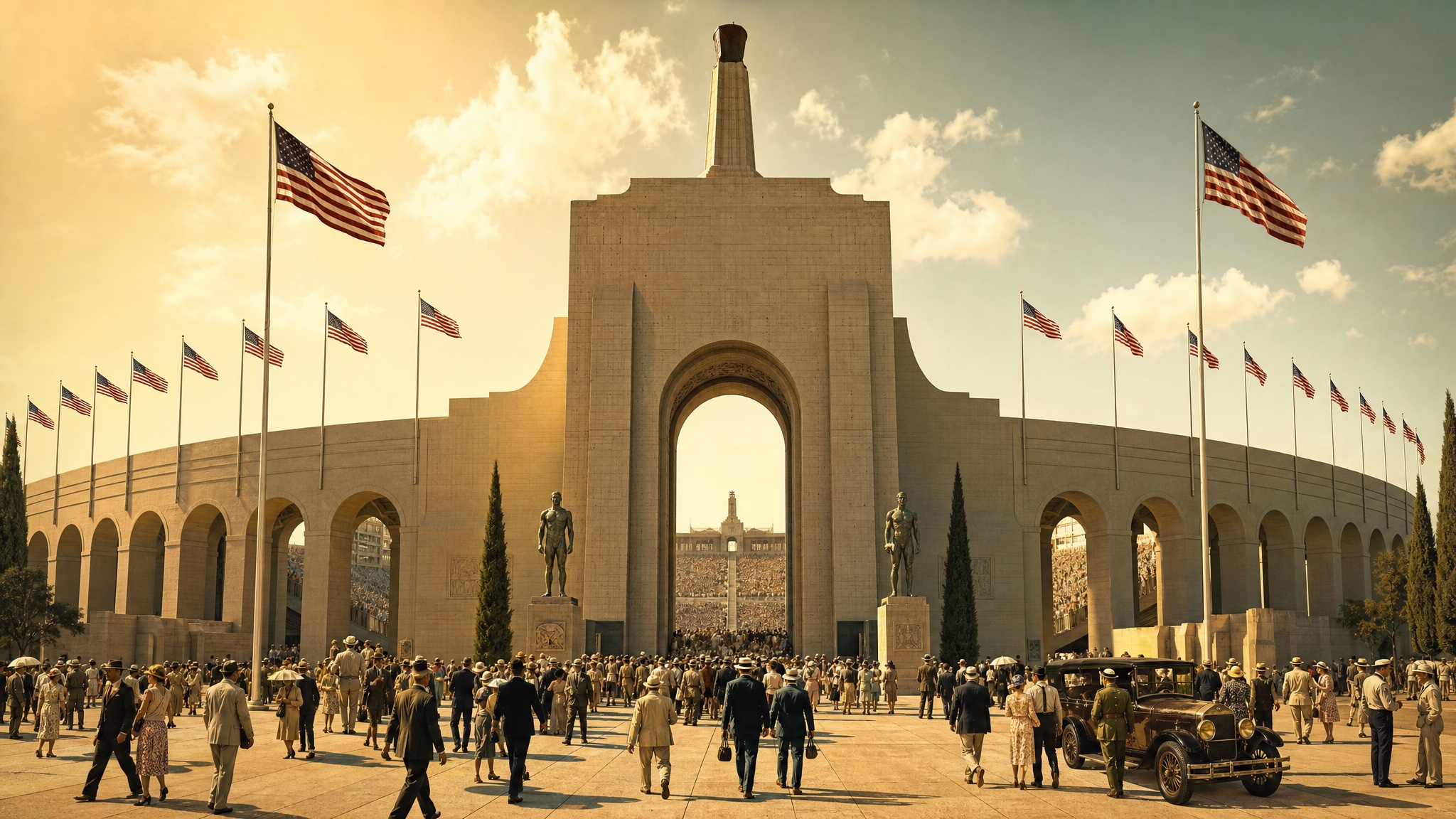
The 1932 Summer Olympics arrived in the shadow of the Great Depression — one of the most economically devastating periods in American history. Despite mass unemployment and global financial hardship, Los Angeles transformed itself into the world's sporting capital for 16 extraordinary days. It was the first time the Games had been held in the western United States.
Because of the economic crisis and the cost of travel to California, attendance was dramatically reduced. Only 37 nations sent athletes — the smallest field since 1904 — yet those who came competed with remarkable intensity. The Games produced record-breaking performances on an unprecedented scale.
Perhaps the most lasting innovation of the 1932 Games was the creation of the first-ever Olympic Village — 500 small cottages constructed in Baldwin Hills to house all male athletes. Before this, athletes had to find and pay for their own accommodation. This single decision changed the Olympic experience forever.
Venues
World First: The Olympic Village
Before 1932, athletes had to find and pay for their own accommodations during the Olympics — often in local boarding houses or hotels. LA changed everything by constructing 500 purpose-built cottages in Baldwin Hills, creating the very first Olympic Village. Women athletes stayed at the Chapman Park Hotel. This model was so successful that every Olympics since has built a dedicated village.
🏅 1932 Medal Table — Top 10
37 Nations Competed| # | Nation | 🥇 | 🥈 | 🥉 | Total |
|---|---|---|---|---|---|
| 1 | 🇺🇸 United States | 41 | 32 | 30 | 103 |
| 2 | 🇮🇹 Italy | 12 | 12 | 12 | 36 |
| 3 | 🇫🇷 France | 10 | 5 | 4 | 19 |
| 4 | 🇸🇪 Sweden | 9 | 5 | 9 | 23 |
| 5 | 🇯🇵 Japan | 7 | 7 | 4 | 18 |
| 6 | 🇭🇺 Hungary | 6 | 4 | 5 | 15 |
| 7 | 🇫🇮 Finland | 5 | 8 | 12 | 25 |
| 8 | 🇬🇧 Great Britain | 4 | 7 | 5 | 16 |
| 9 | 🇦🇺 Australia | 3 | 1 | 1 | 5 |
| 10 | 🇦🇷 Argentina | 3 | 1 | 0 | 4 |
Star Athletes of 1932
Babe Didrikson
The most dominant athlete of the 1932 Games. Didrikson won gold in the 80m hurdles and javelin, plus silver in the high jump — the only rules limiting her was the IOC's restriction on how many events women could enter. A legend of American sports.
Eddie Tolan
The "Midnight Express" from Detroit became the fastest man alive in 1932, winning both the 100m and 200m gold medals in LA. Tolan set Olympic records in both events, cementing himself as one of the greats of American sprinting.
Clarence "Buster" Crabbe
Won gold in the 400m freestyle by just 1/10th of a second in a photo finish. Crabbe later became a Hollywood star playing Flash Gordon and Tarzan — one of the most famous examples of an Olympic champion-turned-actor.
Ivar Ballangrud
Norway's speed skating legend dominated the Winter Games. His consistency over multiple Olympics made him one of the most decorated speed skaters of the era — a testament to the athletic depth on display in LA.
The 1984 Summer Olympics
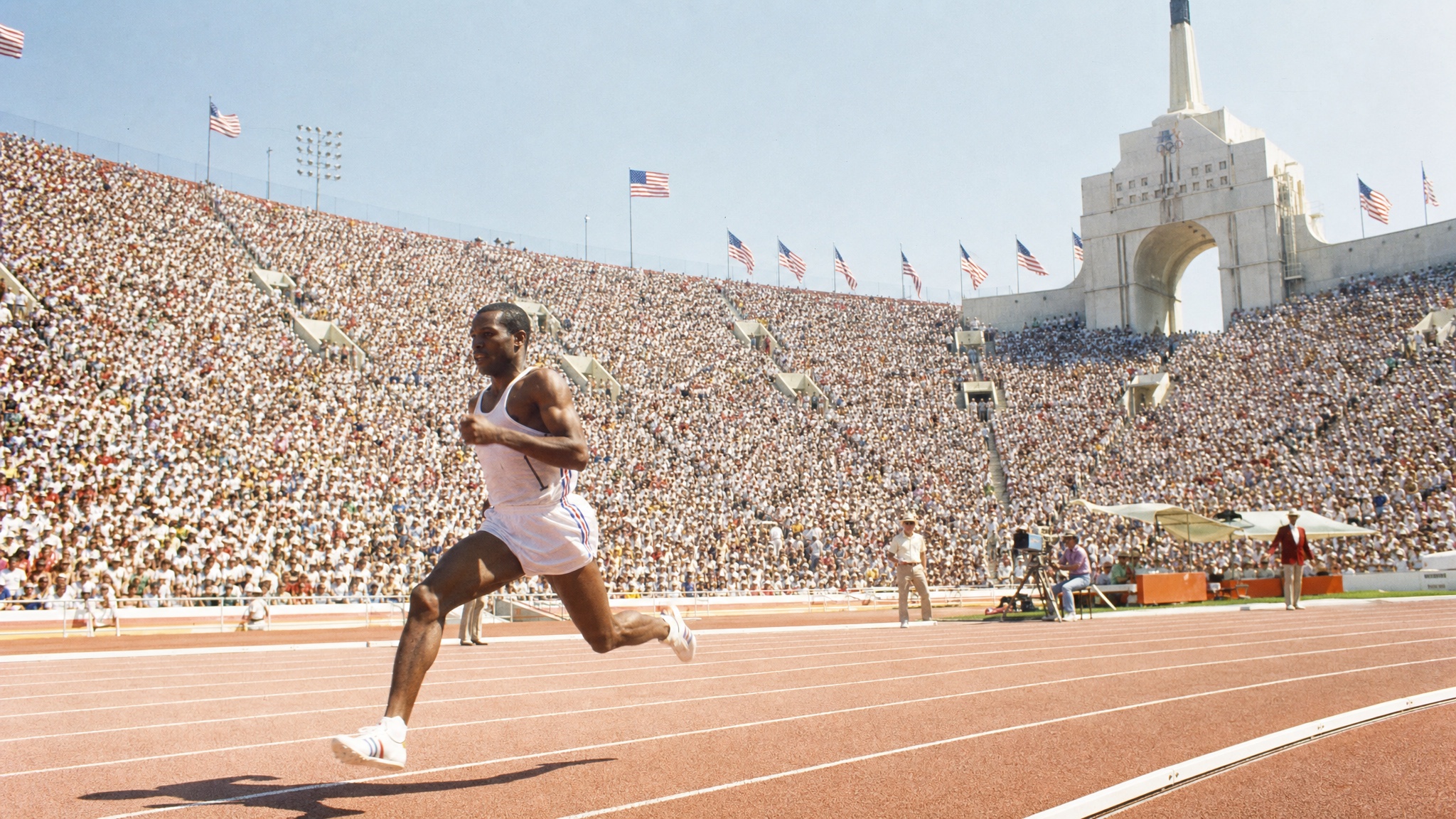
The 1984 Summer Olympics were supposed to be boycotted, overshadowed, and underwhelming. They became one of the greatest Olympic Games in history. After the US-led boycott of the 1980 Moscow Games, the Soviet Union led a reciprocal boycott of the 1984 LA Games — yet despite 14 Eastern Bloc nations staying home, 140 nations attended, the largest participation in Olympic history at that time.
What made 1984 truly transformative was Peter Ueberroth's revolutionary financing model. For the first time, the Olympics were run as a private enterprise with corporate sponsorship rather than public funds. The Games generated a stunning $225 million profit — something that had never happened before and changed how every Olympics since has been organized.
The athletic performances were nothing short of extraordinary. Carl Lewis matched Jesse Owens' legendary 1936 feat. A teenage girl from West Virginia delivered a perfect 10 and captured the heart of America. And in the marathon, women competed in the event at the Olympics for the very first time.
Venues
🎆 The Opening Ceremony
On July 28, 1984, 92,655 fans packed the LA Memorial Coliseum for one of the most spectacular opening ceremonies in Olympic history. Rafer Johnson — the 1960 Olympic decathlon champion — carried the torch up the stadium steps and lit the cauldron as the crowd erupted. The ceremony featured hundreds of thousands of colorful balloons released over the city, a sight that became one of the most iconic images of the 1984 Games. The television audience worldwide was estimated at over 2.5 billion people.
🏅 1984 Medal Table — Top 10
140 Nations Competed| # | Nation | 🥇 | 🥈 | 🥉 | Total |
|---|---|---|---|---|---|
| 1 | 🇺🇸 United States | 83 | 61 | 30 | 174 |
| 2 | 🇷🇴 Romania | 20 | 16 | 17 | 53 |
| 3 | 🇩🇪 West Germany | 17 | 19 | 23 | 59 |
| 4 | 🇨🇳 China | 15 | 8 | 9 | 32 |
| 5 | 🇮🇹 Italy | 14 | 6 | 12 | 32 |
| 6 | 🇨🇦 Canada | 10 | 18 | 16 | 44 |
| 7 | 🇯🇵 Japan | 10 | 8 | 14 | 32 |
| 8 | 🇳🇿 New Zealand | 8 | 1 | 2 | 11 |
| 9 | 🇾🇺 Yugoslavia | 7 | 4 | 7 | 18 |
| 10 | 🇰🇷 South Korea | 6 | 6 | 7 | 19 |
Star Athletes of 1984
Carl Lewis
The greatest performance of the 1984 Games. Lewis won four gold medals — 100m, 200m, long jump, and 4×100m relay — matching Jesse Owens' legendary feat from the 1936 Berlin Olympics. Widely considered one of the greatest Olympic athletes of all time.
Mary Lou Retton
The 16-year-old from Fairmont, West Virginia, needed a perfect 10 in the vault to win the all-around gold medal. She got it — twice. Retton became the first American woman to win the Olympic gymnastics all-around and the face of American sports in 1984.
Edwin Moses
Won gold in the 400m hurdles as part of a legendary unbeaten streak spanning 9 years and 122 consecutive races (1977–1987). Moses was so dominant in his event that he revolutionized the technical approach to hurdle racing.
Joan Benoit
Won the very first women's Olympic marathon — a race that only came into existence at the 1984 Games. Benoit entered the Coliseum to a standing ovation from 77,000 fans, completing a historic moment for women's athletics worldwide.
Greg Louganis
The greatest diver in history won double gold in platform and springboard diving at the 1984 Games. He repeated the feat in Seoul in 1988, cementing his legacy as the defining champion of Olympic diving.
Michael Jordan
Before his NBA championships and global superstardom, a 21-year-old Michael Jordan won Olympic gold with Team USA in Los Angeles. "Before the Dream Team, there was the 1984 team — and Jordan was already the best player in the world."
Evelyn Ashford
Won gold in the 100m after years of injury and disappointment — including the heartbreak of the 1980 boycott that prevented her from competing in Moscow. Her victory in LA was a deeply personal triumph as much as an athletic one.
Nawal El Moutawakel
Morocco's first Olympic gold medalist and the first Muslim woman ever to win an Olympic title. Her victory in the 400m hurdles sparked celebrations across the Arab world and inspired generations of women athletes from Muslim nations.
📋 The 1984 Legacy: How LA Changed the Olympics Forever
- First privately financed Olympics — Peter Ueberroth replaced public funding with corporate sponsorships, generating $225M profit and saving the Olympic movement from financial ruin.
- Corporate sponsorship model — TOP (The Olympic Programme) sponsorships, pioneered in 1984, remain the backbone of Olympic financing today.
- Largest Olympic participation — Despite the Soviet boycott, 140 nations attended — a record at the time showing the Olympics could thrive without political rivals.
- Women's marathon debut — Joan Benoit's gold was a watershed moment for women's long-distance running globally.
- International broadcast revolution — ABC's coverage reached 2.5 billion viewers, making the 1984 Games a landmark in sports broadcasting history.
- The LA template — Every modern Olympics looks to 1984 LA as the blueprint for running the Games efficiently and profitably.
Planning to Witness History in 2028?
Book your hotel in Los Angeles early — venues for the 2028 Games sell out fast, and accommodation near iconic Olympic sites like SoFi Stadium and the Coliseum fills up years in advance.
The 2028 Summer Olympics
On July 14, 2028, Los Angeles will make history for the third time, joining London and Paris as the only cities ever to host the Summer Olympics on three occasions. It is, simply put, a city built for this moment — with world-class venues already in place, a perfect climate for outdoor athletics, and a cultural energy unlike anywhere on earth.
The LA28 Games are expected to attract 15,000 athletes from 200+ nations, watched by an estimated 4 billion television viewers worldwide. Unlike many recent Olympics, LA28 is relying primarily on existing venues — avoiding the costly infrastructure spending that has plagued cities like Rio de Janeiro and Athens for decades after the Games.
2028 Venues
SoFi Stadium
Opening & Closing Ceremonies · State-of-the-art $5B stadium in Inglewood, home of the Rams and Chargers.
LA Memorial Coliseum
Athletics (Track & Field) · The iconic 100-year-old Coliseum hosting its third Olympic Games — a living monument to LA's history.
Crypto.com Arena
Boxing & Basketball · Home of the Lakers and Clippers, one of the most iconic arenas in American sports.
Rose Bowl, Pasadena
Football (Soccer) · The legendary stadium hosting Olympic soccer for the third time, after 1932 and 1984.
Intuit Dome
Gymnastics & Sports · The Clippers' brand-new arena in Inglewood — one of the most technologically advanced sports venues ever built.
Long Beach / Santa Monica
Beach Volleyball, Cycling & Sailing · Iconic coastal venues bringing the Pacific Ocean backdrop to Olympic competition.
New Sports for 2028
LA28 introduces five new sports — the biggest single expansion of the Olympic program in decades:
→ See our full 2028 Sports Guide for every event, schedule, and venue
Only the Third City in History
With 2028, Los Angeles joins an extraordinarily exclusive club. Only London (1908, 1948, 2012) and Paris (1900, 1924, 2024) have hosted the Summer Olympics three times. Every other city in Olympic history has hosted at most twice. LA's third Games cements the city's place as one of the greatest Olympic hosts in the 128-year modern Games era.